Eurozone Debt
During my undergrad research I got interested in the impact of public debt on economic growth. I ran some regressions examining whether changes in short-term rates, household saving rates, GDP growth, equity prices, and exchange rates were associated with changes in the debt to GDP ratio and nominal debt levels. I looked at the U.S. and the U.K. I found saving rates to be significant in predicting changes in debt to GDP ratios and changes in nominal debt in the U.S. linear models. The sign was positive and statistically significant in both equations. Increases in the household saving rate were associated with faster nominal public debt growth and increases in the debt to GDP ratio. That went against my intuition because I expected declines in household saving to be associated with faster debt growth. I wasn’t looking at household debt, so that makes sense looking back. During U.S. recessions for example government borrowing and household savings can rise simultaneously via fiscal transfers (see Covid-19). I also did not have today’s AI tools to help accelerate the research process.
That got me thinking recently about the Eurozone. It’s an interesting question to explore how savings at the national level influence economic conditions since Eurozone countries share a single currency. The ECB sets one common monetary policy stance. Each country has its own sovereign spread because market forces assign each country a different combination of fiscal, political, and liquidity risk. The euro removes national currency depreciation as an adjustment mechanism. Spain can’t devalue against Germany. As a result, countries absorb economic changes through internal adjustment. This post isn’t really a “framework” but rather an attempt to trace how national saving, sovereign debt, and a common central bank interact.
The Eurozone crisis began when private investors stopped treating the debts of member governments as close substitutes. Savings moved toward safe places, sovereign spreads widened, and high debt countries faced tough financing conditions. The ECB eventually stepped in and reduced the probability that a retreat by private entities would develop into a self-fulfilling debt crisis. What are the consequences of an ECB backstop that may compress sovereign yields?
Where National Saving Goes
So, last time I looked at one view of the current account using goods and services balances. Another view is that national saving – domestic investment = current account. That can be broken down further into private sector balance (private saving – domestic investment) + government balance (tax revenue – government spending) = CA. A current account surplus means the country is a net lender to the rest of the world. A current account deficit means the country is a net borrower. Excess savings are invested abroad through loans, bonds, or other financial claims (or a reduction in foreign liabilities). Individual savers may still hold domestic assets because transactions among domestic sectors cancel when the country is viewed as a whole.
If domestic savers buy their government’s bonds, the government may be less dependent on foreign investors. If savers prefer foreign assets or equities, domestic saving might not reduce the sovereign yield. All else equal, lower demand for bonds means a lower bond price and a higher yield.
National saving contributes to the resources available for acquiring claims at home and abroad. Sovereign deficits determine part of the supply of those claims. ECB purchases and the expectation of intervention affect the yield at which the market clears, altering the price through which the eurozone saving is allocated.
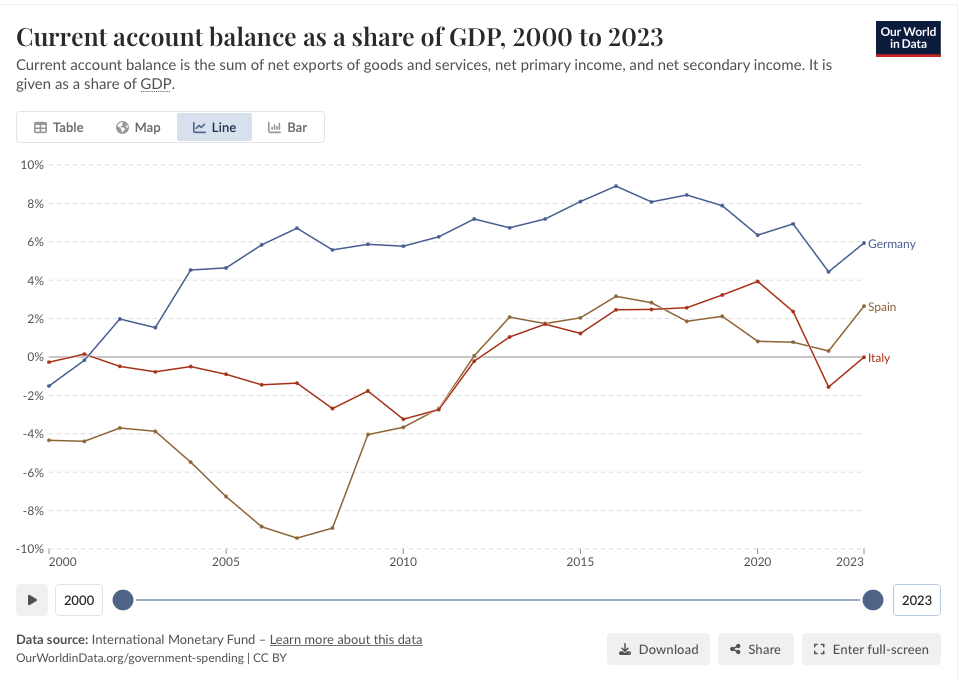
Going back to cross border flows. Because Germany and Spain use the same currency, German banks could extend credit to Spain or acquire Spanish financial claims without facing exchange-rate risk between the two countries. That is good for Spanish borrowing costs. Pre-crisis, northern European savings financed southern European credit. During the crisis, the Eurosystem partly filled the gap by lending central bank money to stressed banks.
One Currency, Different Players
Consider three countries: Germany, Italy, and Spain. Germany, we know about a bit. Excess national saving, weak domestic investment, big on exports, big current account surpluses. A net accumulator of foreign claims. Spain got cheap cross border financing pre-crisis that supported a property boom. The boom collapsed and banks lost a lot of money. Spain entered the crisis with low public debt. By the start of the eurozone crisis, Italy had very high public debt and weak productivity. There was no Spanish style private-credit boom; its vulnerability came from weak growth and refinancing issues.
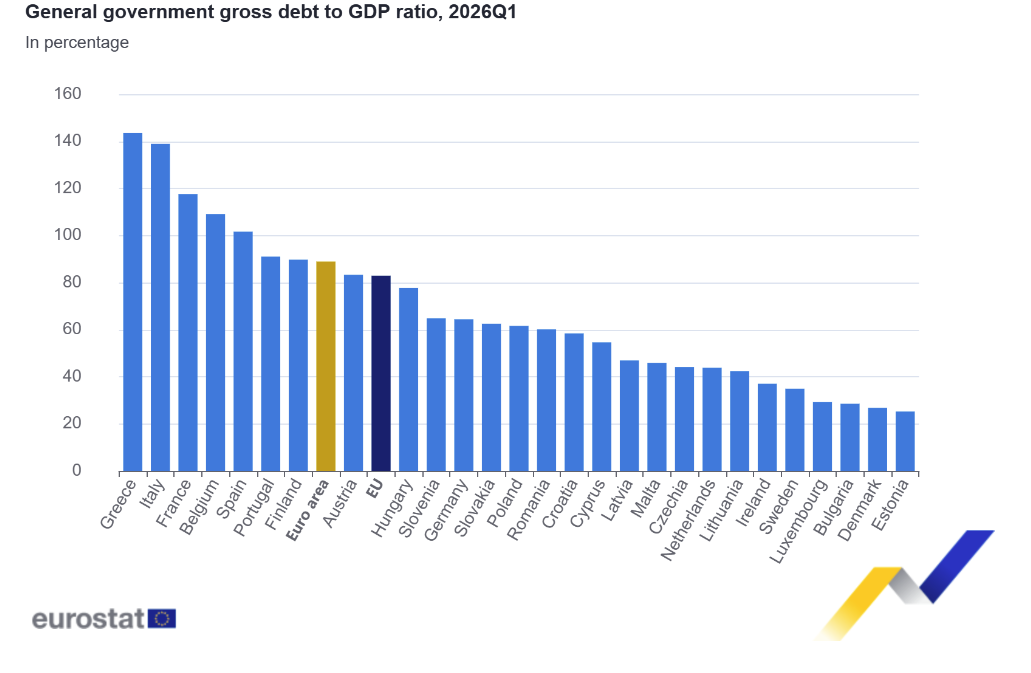
Present day debt:
Financial markets behaved as though everyone was having fun until 2008. The 2008 crisis exposed the differences between those countries. The differences were manageable while private investors treated national debts as close substitutes. The eurozone crisis began when they stopped. The timeline of events followed something like September 2008 – Lehman collapsed. Global banks stopped trusting each other, cross-border financing dropped, world trade dropped. 2009 – private losses became public problems. Lower tax revenue and high unemployment widened government deficits. Late 2009 – Greece revealed problems with its deficit and debt position. Other countries were like “oh no eurozone sovereign bonds may be riskier than we thought!” By late 2010, contagion spread beyond Greece. Ireland had a banking crisis. Spanish and Italian spreads eventually rose. By summer 2011, Bund yields fell because investors sought safety, and the ECB began buying Italian and Spanish bonds. Spain and Italy couldn’t devalue against Germany. Adjustment occurred through employment, wages, credit contraction, and domestic demand.
The feedback loop during a debt crisis can be something like –> private investors retreat bond prices fall and yields rise –> banks holding the bonds suffer losses –> government refinancing becomes more expensive –> the fiscal outlook worsens –> yields go up more. If rising yields had been allowed to perform all the adjustment, they may have imposed fiscal discipline on higher debt countries. That may have also led to a self-fulfilling collapse. The ECB wanted to prevent the second outcome. Understandably so.
The eurozone crisis was partly a breakdown in private financial intermediation. Before the crisis, banks and investors recycled capital across the monetary union, while private markets largely priced national sovereign risk. After cross border intermediation broke down, the ECB increasingly treated sovereign market fragmentation as an obstacle to monetary policy itself. It therefore began backstopping bond markets.
The ECB Put
Eurozone yields can be decomposed into y = expected ECB rates + term premium + credit/liquidity risk + redenomination risk – expected ECB support.
Redenomination risk means a country may leave the euro, get its own currency and have that currency devalue. There’s a risk that you get paid back in fewer euros. A country leaving and having its currency appreciate is also possible. That could keep Bund yields lower, for example. So, all eurozone countries have the same expected ECB rates, but different premiums.
ECB intervention changes these premiums. Draghi’s 2012 promise to do “whatever it takes” reduced the perceived probability of euro breakup. In March 2020, Italian yields rose sharply after Lagarde said the ECB was “not here to close spreads.” The ECB subsequently introduced the Pandemic Emergency Purchase Programme (PEPP). This was a temporary asset purchase program covering private and public sector securities. In 2022, the ECB used flexible PEPP reinvestments to counter renewed spread widening and created the Transmission Protection Instrument (TPI). The TPI would allow the ECB to make targeted secondary market purchases of eligible public sector securities with remaining maturities between one and ten years. Any purchases would focus on “jurisdictions experiencing a deterioration in financing conditions not warranted by country-specific fundamentals.” The TPI remains available but has never been activated.
Markets treated eurozone debt as relatively interchangeable before 2008, differentiated sharply among governments during the sovereign crisis, and subsequently priced in a stronger ECB backstop:
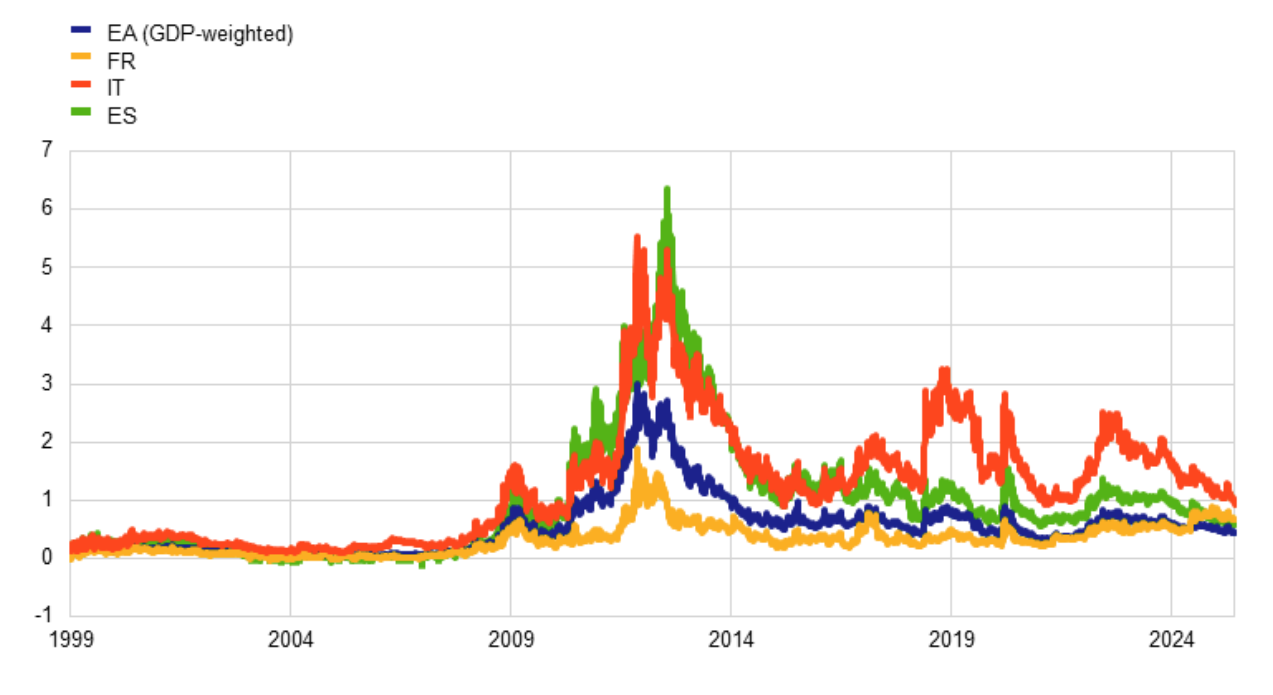 The above is from ecb.europa.eu and shows 10 year Bund spreads. EA means “euro area”
Robin Brooks (my favorite commentator on Substack right now), interprets these interventions as evidence that the ECB caps peripheral yields. His central point is that a credible backstop can lower yields even without continuous purchases. If investors expect the ECB to intervene during severe market stress, Italian and Spanish bonds become safer to own, increasing private demand at lower yields.
The counterfactual here is important. Italy’s “shadow yield” – the yield it would pay without ECB support – cannot be observed directly. Nor are Bund yields an undistorted benchmark because they also reflect ECB policy and safe-haven demand. The question is which premium the ECB removes. If it eliminates self-fulfilling liquidity risk, it is providing monetary insurance. If it suppresses compensation for genuine fiscal risk, it is subsidizing high-debt governments. Or maybe the two aren’t mutually exclusive?
Is Germany Underwriting Italy and Spain?
Germany doesn’t literally send money to Italy and Spain. The benefit mainly comes through borrowing costs. If membership in the eurozone allows Italy to refinance its large debt stock at lower rates than it would otherwise pay, then the Italian government is saving money. Spain complicates a simple north versus south story. It has run current account surpluses for more than a decade and is now a net lender to the rest of the world. Its government nevertheless continues to run a fiscal deficit and carries public debt of roughly 100% of GDP.
Germany also participates in the sharing of some Eurosystem income and financial risk. The Bundesbank has roughly a 26% share of the Eurosystem capital key, meaning it generally receives the largest portion of jointly allocated income and bears the largest portion of mutually shared losses. But this does not mean Germany guarantees 26% of Italian or Spanish debt. Risk-sharing varies by program, and much of the sovereign debt purchased by national central banks has remained on their own balance sheets. Germany’s exposure is therefore contingent and program specific.
Brooks argues that the deeper subsidy comes from the eurozone’s political incentives. Highly indebted members have a strong interest in policies that prevent their financing costs from rising. There is a “principal-agent problem.” The ECB has the job of conducting monetary policy, but it has gradually taken decisions that redistribute financial risks among countries. In his view, the ECB has allowed highly indebted governments to delay fiscal adjustment. The counterargument is that ECB officials are not formally national representatives and that stabilizing monetary policy transmission is part of conducting a common monetary policy.
The arrangement does not benefit only Italy and Spain. Investors often move into Bunds during periods of stress. That reduces German borrowing costs. German exporters may also benefit from using a euro that is potentially weaker than a standalone deutsche mark. It is fair to say that Germany helps underwrite a system that makes severe financing crises in Italy and Spain less likely, while Germany receives its own borrowing and trade benefits.
Conclusion
My undergrad result – that increases in household saving predicted increases in U.S. government debt – initially seemed backward because I assumed more saving should mean less debt. What I missed was that one sector’s financial asset is another sector’s liability. During a recession, households can save more while the government borrows more. The eurozone adds a cross-border dimension to the relationship. German national saving can become a claim on borrowers elsewhere, while Italian and Spanish liabilities can be held by investors both inside and outside the eurozone. Before 2008, private banks and investors did much of this recycling.
The ECB interventions eventually reduced the risk that capital flight would create a self-fulfilling sovereign crisis, but they also changed the market price that allocates savings and disciplines borrowers. Without national exchange rates, the pressure moves onto labor markets, fiscal policy, sovereign yields, and ultimately the ECB’s balance sheet. The unresolved question is whether the ECB is insuring the eurozone against unnecessary financial panics or protecting governments from the consequences of their fiscal choices. The answer is probably some combination of both.